

WELCOME TO FRIENDS OF SECOND STREET.
We’ve gathered the key facts, context and questions surrounding the Bliss redevelopment in one place. Take a look for yourself—and if you believe Hudson deserves better housing and a better plan, please sign the petition.
FoSS endorses Bliss Gardens
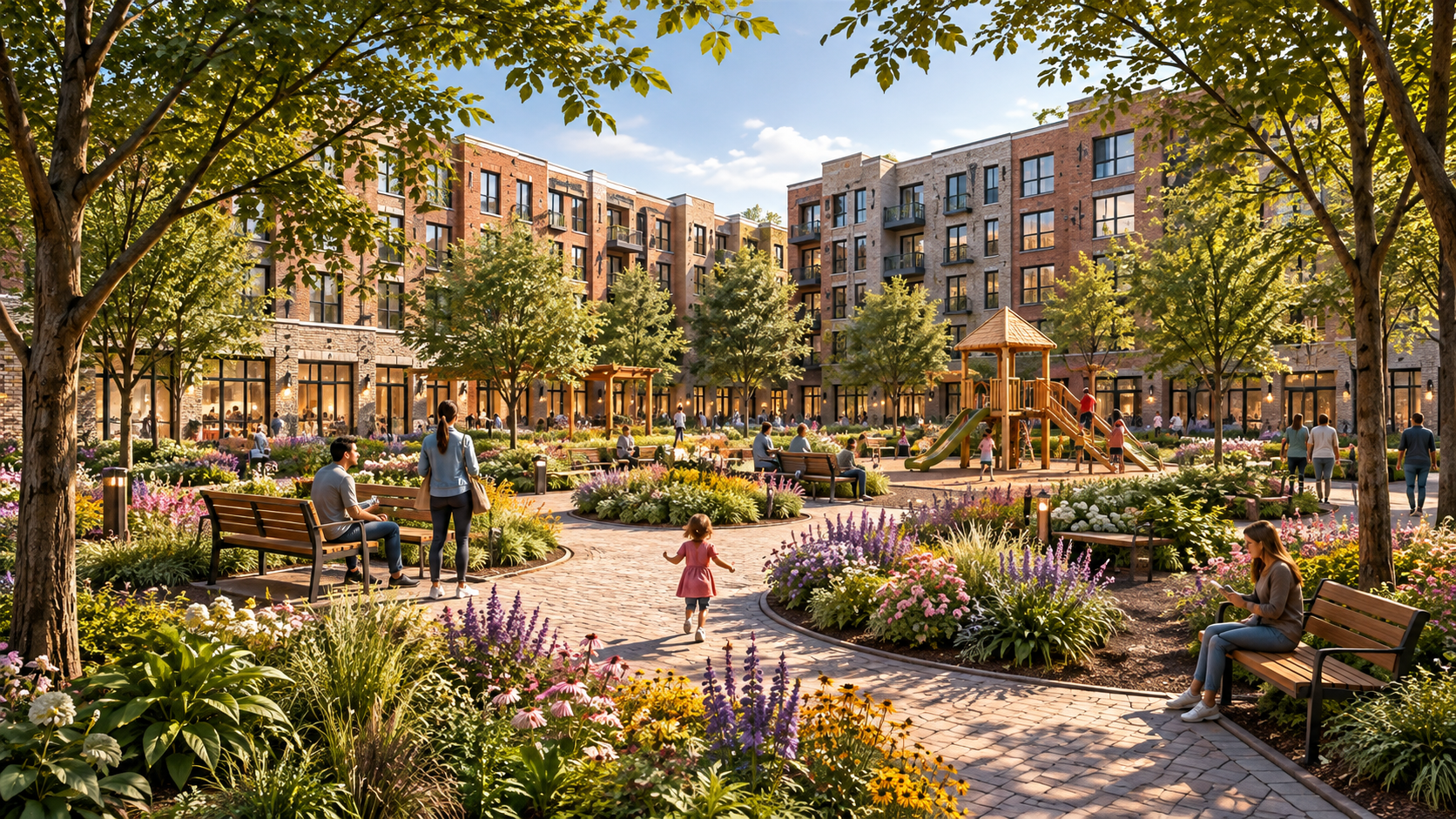
Early view of the proposed homes and shared gardens at Bliss Gardens. The design is a working concept and will continue to develop. Image courtesy of Project7Hudson.
Friends of Second Street endorses Bliss Gardens, the alternative affordable housing proposal being developed by Project7Hudson. The working plan calls for approximately 140 new homes on the existing Bliss property, followed by residents moving in and the demolition of Bliss Towers and Columbia Apartments. It proposes including demolition funding from the start, creating gardens and a future park, and keeping the recreation parcel across State Street for community use.
The design, cost, financing, and schedule still need to be tested. FoSS believes residents and Hudson deserve the chance to examine this alternative before a lasting decision is made.
BLISS: IT’S COMPLICATED.
Better housing is the goal. Getting there is the complicated part.
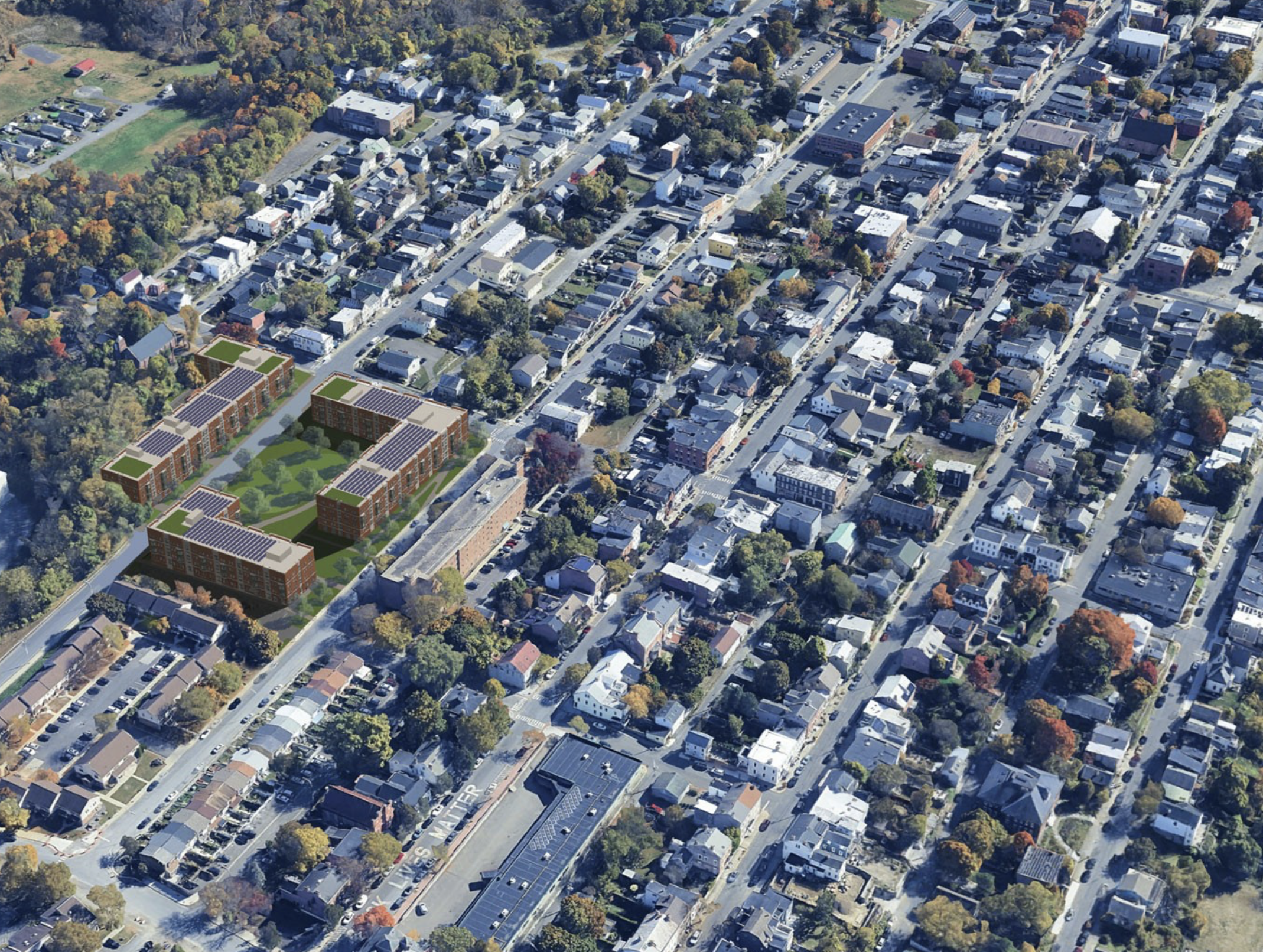
The Bliss Redevelopment in Context
Concept rendering of the proposed full buildout within Hudson’s Second Ward—showing the scale of the project in relation to the city and neighborhood around it. Image source: Hudson Housing Authority (HHA)/Mountco (developer)/Gorlin Architects
The Hudson Housing Authority is proposing to completely remake Bliss. What exists today is a 135-unit public-housing complex. What is being proposed is somewhere around 266 to 276 apartments—the number has changed as the plans have changed. Either way, the basic fact is easy to understand: the redevelopment would roughly double the number of apartments at Bliss. HHA’s current plan describes 166 units in Phase 1 and approximately 100 more in Phase 2; earlier versions put the final total at 276.
And even 135 doesn’t quite describe Bliss today. Of the 120 apartments in Bliss Towers, only about 75 are currently occupied; roughly 45 have been taken offline because of the deteriorated condition of the building, according to HHA Board Member Sara Black at the August 24 site walk. Approximately 130 residents are now waiting for something everyone agrees they urgently need: safe, dignified new housing.
Here’s where it gets complicated. Bliss Towers cannot simply be torn down and replaced. Phase 1 has to be built first so current residents can move into the new apartments. Only then can the nine-story tower and Columbia Apartments be demolished, which clears the way for Phase 2. Phase 1 construction alone has been discussed as roughly two years once financing and approvals are in place. Add remediation, difficult soil conditions, ground improvement, demolition and an entire second phase, and the full redevelopment is a years-long construction project—with plenty of opportunities for delays along the way.
The project is getting bigger geographically, too. The existing Bliss property is roughly three acres; the overall redevelopment now encompasses approximately 4.56 acres. Much of Phase 1 would be placed on the roughly 1.4-acre open parcel across State Street—the field many neighbors have long experienced and used as green space. Eight large mature trees are expected to be removed there. The parcel is also a designated brownfield, with contamination requiring state-supervised investigation and remediation, and its clay-heavy soils require substantial ground improvement before the new building can be supported.
Then there is North Second Street. Phase 1 shifts much of the development’s vehicle activity toward this relatively small neighborhood street. A new 51-space parking area would enter and exit through a single portal onto North Second; townhouse parking adds another access point; and changes to State Street—including a one-way configuration that has been discussed—would alter circulation again. More residents also mean more visitors, deliveries, maintenance, sanitation and emergency vehicles. The question is not simply whether the cars fit on a traffic study. It is what happens to the street when all of these changes occur together.
And then there is the money. The redevelopment has previously been estimated at more than $220 million — approaching a quarter of a billion dollars. Depending on whether the final buildout is 266 or 276 apartments, that works out to roughly $800,000–$830,000 per unit.
That is a striking figure even compared with recent affordable-housing projects in much more expensive New York City markets. Recent Bronx developments have come in at roughly $560,000–$620,000 per apartment, while the new 292-unit River Avenue II project is about $770,000 per unit.
Closer to home, Kingston’s newly completed Golden Hill Apartments created 164 affordable apartments for $87 million — about $530,000 per unit, roughly two-thirds of the estimated per-unit cost at Bliss.
These projects are not identical, and per-unit comparisons cannot explain every difference in site conditions, financing or program. But the contrast is significant enough to raise a basic question: why is Bliss projected to cost so much?
All of this is happening in a city whose latest U.S. Census Bureau estimate is just 5,721 people. A redevelopment approaching a quarter-billion dollars, roughly doubling the housing on the site, changing more than four acres of the Second Ward and unfolding over multiple years is an extraordinary undertaking for a city this size.
And yet the plan is still changing. HHA itself calls it a Revised Preliminary Redevelopment Plan and says it remains subject to revision. Design, zoning, environmental review, financing, permits and local approvals are all interconnected—and several remain incomplete.
That’s why FoSS believes Hudson should slow down enough to understand what is actually being proposed.
We support new and better housing for Bliss residents. The question is not whether Bliss should be rebuilt. The question is whether a project this large, expensive and consequential is being planned as carefully as it needs to be.
QUESTIONS HUDSON SHOULD BE ASKING
The Bliss redevelopment is complicated. We’ve broken down some of the most important issues—one question at a time.
-
HUDSON’S AFFORDABLE HOUSING IN CONTEXT
Nearby New York Communities
HUDSON
Population: ≈5,700
Subsidized / supportive housing: 16.5%CATSKILL VILLAGE
Population: ≈3,745
Subsidized / supportive housing: ≈7–8%SAUGERTIES VILLAGE
Population: ≈3,899
Subsidized / supportive housing: ≈5%RHINEBECK VILLAGE
Population: ≈2,697
Subsidized / supportive housing: ≈5.5%BEACON
Population: ≈14,800
Subsidized / supportive housing: ≈7.7%KINGSTON
Population: ≈24,000
Subsidized / supportive housing: ≈12%POUGHKEEPSIE
Population: ≈31,500
Subsidized / supportive housing: ≈8.6%Percentages are approximate. Municipalities do not all categorize subsidized, supportive and other affordable housing programs in exactly the same way.
And this is Hudson today. The city’s current housing analysis reports that 16.5% of Hudson’s housing stock is already subsidized or supportive housing. If the Bliss redevelopment is completed at roughly 266–276 units, it would add approximately 131–141 net new affordable apartments beyond the 135 units that exist there today. Holding the rest of the city’s housing stock constant, Hudson’s subsidized/supportive share would rise to roughly 20% — about one out of every five homes in the city.
For a city of only about 5,700 people, that is a significant shift in the composition of its housing stock and one more reason the scale of the Bliss redevelopment deserves careful public consideration.
This is not simply a replacement of the existing tower. It is a large-scale redevelopment that would reshape this part of Hudson for decades.
TODAY — SECOND WARD
About 345 subsidized/affordable units
Roughly 49% of the Ward’s housing — essentially one out of every two homes.AFTER FULL BLISS BUILDOUT
Bliss grows from 135 to approximately 266–276 units, so the Second Ward gains a net 131–141 additional affordable units. HHA currently describes Phase 1 as replacing the 135 existing units plus 31 additional units, with Phase 2 projected to add about another 100.That would put the Second Ward at roughly 476–486 subsidized/affordable units, or approximately 57% of its housing stock — approaching three out of every five homes in the Ward.
The simple takeaway for FoSS
Today, roughly half of the housing in Hudson’s Second Ward is already subsidized or income-restricted. If the full Bliss redevelopment is completed, that share could approach 60% — nearly three out of every five homes in the Ward.
-
In 2021, Hudson adopted an Affordable Housing Development Plan that encouraged creating affordable housing across multiple sites and neighborhoods rather than concentrating it in one area. The City later explained that this approach provides residents with greater neighborhood choice, allows for smaller-scale development that can fit more naturally into existing neighborhoods, and helps create more economically diverse communities.
FoSS believes that principle deserves renewed attention. The issue is not who lives in affordable housing, nor whether Hudson needs more of it. The question is whether a citywide housing need should be met by placing an increasingly large share of that housing—and its accompanying development—within one small part of the city.
Affordable housing throughout Hudson creates choice and shared opportunity. Concentrating more and more of it in one neighborhood does the opposite.
-
Hudson’s 2021 Affordable Housing Development Plan did not prohibit larger affordable-housing projects, and Bliss presents a separate problem: HHA says its existing 135 apartments are deteriorated beyond feasible rehabilitation and must be replaced. HHA therefore argues that redevelopment of the site is necessary and that adding units there helps meet Hudson’s broader need for affordable housing.
But the City’s own plan also endorsed scattered-site housing specifically to avoid concentrating lower-income households in one neighborhood, provide residents more choice in where they live, and allow smaller developments to fit more naturally throughout Hudson. The City repeated that principle when it advanced its scattered-site proposal in 2022.
That is where FoSS believes an important distinction should be made: replacing the 135 existing Bliss units is one question; adding roughly 130–140 more units at the same location is another.
If Hudson has already identified distribution and neighborhood choice as good housing policy, why should so much of the city’s next generation of affordable housing be concentrated in the Second Ward rather than distributed throughout Hudson?
-
Everyone agrees on the most important point: the approximately 130 people still living at Bliss and Columbia need safe, dignified housing as soon as possible. FoSS strongly supports that goal.
But under the current plan, those residents cannot leave until Phase 1 is built. And Phase 1 is unusually complicated: it requires financing, multiple approvals, brownfield remediation, major ground stabilization on difficult soils, construction, and resolution of other planning and zoning issues. Any one of those steps could cause delay; litigation or unforeseen site conditions could add more. Even under an optimistic schedule, residents could remain in the existing buildings for several more years.
That raises a basic question: what happens if Phase 1 takes longer than expected—or if conditions at Bliss deteriorate faster than the new housing can be delivered?
After years of planning, we have not seen a publicly presented contingency relocation strategy. If one exists, HHA should show it. If it does not, one should be created now. The welfare of 130 residents should not depend entirely on every financial, environmental, engineering and legal component of one enormous redevelopment proceeding exactly as planned.
-
HHA already controls a roughly 3-acre residential property containing Bliss Towers and the largely vacant Columbia Apartments. Yet much of Phase 1 is proposed across State Street on a much smaller 1.4-acre site that requires brownfield remediation, major ground stabilization, removal of mature trees and open/recreation space, and construction of a new 51-car parking area with access onto North Second Street.
At the August 24 site walk, HHA representatives said only one household remained in Columbia Apartments. Those buildings are already scheduled for demolition. So why not first study whether removing them could allow substantially more replacement housing to be built on the larger, already-developed HHA property while Bliss Towers remains occupied?
That alternative could potentially mean less remediation, less difficult foundation work, fewer traffic impacts, lower costs and preservation of more of the existing green space and mature tree canopy. The smaller parcel could even become part of the meaningful open space HHA promises for the completed redevelopment.
FoSS is not claiming this alternative will work. We are asking why it has not been shown and compared. For a project approaching a quarter of a billion dollars, Hudson deserves to see whether there is a faster, simpler and less disruptive way to get current Bliss residents into new homes.
-
The biggest change may not be height, but mass and length. Bliss Towers is approximately 90 feet tall, but it is a relatively narrow building surrounded by open space. The redevelopment would take much of that vertical mass and spread it horizontally along North Second Street.
Based on the current plans, Phase 1 could place roughly 65–70 feet of four-story building frontage along North Second. If Phase 2 is built substantially as shown in the master-plan renderings, another 160–180 feet could follow across State Street—potentially creating 225–250 feet of new multi-story building frontage along this short stretch.
The issue is not simply four- or five-story buildings. Hudson’s streets are often dense, but their character comes from narrow façades, individual entrances, varied rooflines, setbacks, trees and architectural detail. Long, repetitive institutional-scale façades create a very different streetscape.
It is almost as though Bliss Towers is being turned on its side and laid along North Second Street—twice.
FoSS believes Hudson should not repeat the mistake of 1973 in a different form. Affordable housing can be thoughtfully designed, and density can still feel human in scale. The buildings approved today could define North Second Street for the next fifty years or more.
-
The proposed redevelopment is meant to correct one of the central failures of the 1973 Bliss Towers model: housing that was physically separated from the traditional fabric of the city. The new buildings are lower, but much of the development is organized around a large internal courtyard. That raises an important design question: will residents’ daily lives connect naturally to North Second, State and Columbia Streets—or will the development still turn inward on itself?
Good housing design is about more than brick, windows and height. It is about front doors, sidewalks, trees, porches, gathering places, common spaces and everyday encounters with neighbors. Affordable housing should feel like ordinary, dignified housing woven into Hudson—not like a separate campus with the surrounding streets functioning mainly as its edges, parking entrances and service routes.
The lesson of Bliss should not simply be that a nine-story tower was too tall. The deeper lesson is that changing the shape of separation does not necessarily eliminate it.
Affordable housing should not merely be located in Hudson. It should feel like it belongs to Hudson—and its residents should feel that Hudson belongs to them.
-
Phase 2 is not guaranteed. HHA describes Phase 1 and the affordable-housing portion of Phase 2 as independent phases, and acknowledges that financing for projects of this scale is competitive and uncertain. Phase 2 is currently projected to add about 100 apartments, but its financing has not been secured.
That matters because after Phase 1 is completed, current residents are intended to move out of Bliss Towers and Columbia Apartments. Those buildings would then be vacant and awaiting demolition. HHA says it may seek separate funding—such as Restore NY, federal earmarks or other public resources—to pay for demolition and preparation of the Phase 2 site.
So what happens if that money is delayed or never arrives? Could Hudson be left for years with an empty nine-story Bliss Tower and vacant Columbia Apartments standing beside newly occupied Phase 1 housing? One of the new Phase 1 buildings is already planned immediately adjacent to the Columbia Apartments.
Bliss Towers has long been described as Hudson’s tallest building; an abandoned nine-story tower in the center of a newly constructed residential development would be a significant issue for the city.
HHA says redevelopment of its existing buildings is necessary. But necessity is not the same as a secured demolition schedule.
Before Phase 1 is approved, Hudson deserves to know: if Phase 2 funding does not materialize as planned, who pays to demolish the old buildings—and how long could they remain standing empty?
-
The Bliss redevelopment would involve far more than simply constructing a new apartment building. Phase 1 is expected to require environmental remediation of the brownfield site and substantial ground improvement. HHA’s redevelopment Q&A describes the proposed method as rammed aggregate piers followed by conventional spread footings. After residents are relocated, the existing Bliss Towers and other buildings would then need to be demolished and the site prepared before Phase 2 construction could begin.
For nearby residents and businesses, that could mean years of construction activity—heavy trucks and equipment, demolition, noise, dust, vibration, street and sidewalk disruptions, construction traffic, parking pressure and potential impacts on neighboring properties. Demolition and remediation also raise important questions about how dust, asbestos and other regulated materials will be contained and monitored.
FoSS believes the public deserves to see a complete construction-impact and phasing plan showing the anticipated timeline for both phases, remediation and demolition procedures, truck routes and hours, noise and dust controls, vibration monitoring, street closures, and protections for neighboring homes and residents.
-
The Bliss redevelopment has been discussed at more than $220 million. Depending on whether the final project contains roughly 266 or 276 apartments, that works out to approximately $800,000–$830,000 per unit.
Here is one way to put that number in perspective. HHA has described a typical proposed one-bedroom as about 670 square feet. If the average per-unit development cost were applied to an apartment that size, it would equal roughly $1,190–$1,240 per square foot.
That is an illustrative comparison—not a true construction-cost-per-square-foot calculation. The project cost includes common areas, infrastructure, remediation, foundations, professional fees, financing and many other expenses beyond the interior of an apartment.
But the comparison is still remarkable. Hudson homes are currently selling at a median of about $350 per square foot. And in March 2026, a high-end townhouse at 522 Warren Street sold for $1.8 million—about $537 per square foot.
So even compared with one of Hudson’s expensive million-dollar-plus homes, the illustrative Bliss figure is more than twice as high per square foot.
That does not prove the apartments are overpriced. It does make one question unavoidable: what is driving the cost so high?
-
The proposed redevelopment would increase the site from 135 apartments to approximately 276. But the public still has not been given a reliable projection of how many people—including how many school-age children—could live there when both phases are completed.
The U.S. Census Bureau currently reports an average of 1.91 persons per household across Hudson as a whole. In a letter submitted to the Planning Board, Steve Dunn—a Hudson homeowner and former member of the Hudson Zoning Board of Appeals—used a slightly higher, but still cautious, estimate of 2.1 persons per apartment. At that rate, 276 apartments would accommodate approximately 580 residents.
That figure should not be mistaken for the project’s maximum potential population. A citywide average includes many people living alone and may not accurately reflect a new affordable-housing development containing a significant number of two- and three-bedroom apartments. If the actual average were 2.3 people per apartment, the development could house approximately 635 residents; at 2.5, approximately 690 residents. Every additional one-tenth of a person per apartment adds roughly 28 residents to the total.
This uncertainty is precisely why the Planning Board should require a project-specific population analysis based on the final number of studios and one-, two-, three- and larger-bedroom apartments, reasonable occupancy assumptions for each apartment type, and projected occupancy during each phase.
This raises a broader question: Why has no responsible City body or elected official—including the Planning Board, the Mayor, the Common Council or another appropriate authority—publicly required a complete fiscal impact analysis? The precise legal responsibility may be shared among different offices, but someone in City government should be asking how many residents the project may ultimately house, what additional services will be required, what revenue the development will contribute and what portion of the long-term cost could fall upon Hudson’s existing taxpayers.
A development of this size will create continuing demands on City services, including roads, sanitation, police and fire protection, as well as the Hudson City School District. If the completed development is fully or partially exempt from property taxes, Hudson must understand whether the revenue it generates will be sufficient to offset the additional public costs associated with it.
This does not mean the project will necessarily cause taxes to rise. It means that without a fiscal impact analysis, neither the Planning Board nor the public can know what the effect will be—next year, ten years from now or after the entire project is completed.
Dunn asked the Planning Board to require an analysis addressing:
The final apartment mix and projected population at full occupancy.
The anticipated number of school-age children during each phase.
The project’s estimated full assessed value and the value of any tax exemptions, PILOTs or other tax arrangements.
The anticipated costs to the City and the Hudson City School District.
The revenue the completed development is expected to generate.
The net annual effect on Hudson’s general fund, school taxes and existing property owners.
Public grants and tax credits may help pay for construction, but the cost of providing municipal and educational services continues year after year. Better housing and responsible fiscal planning should not be competing goals. Hudson deserves both.
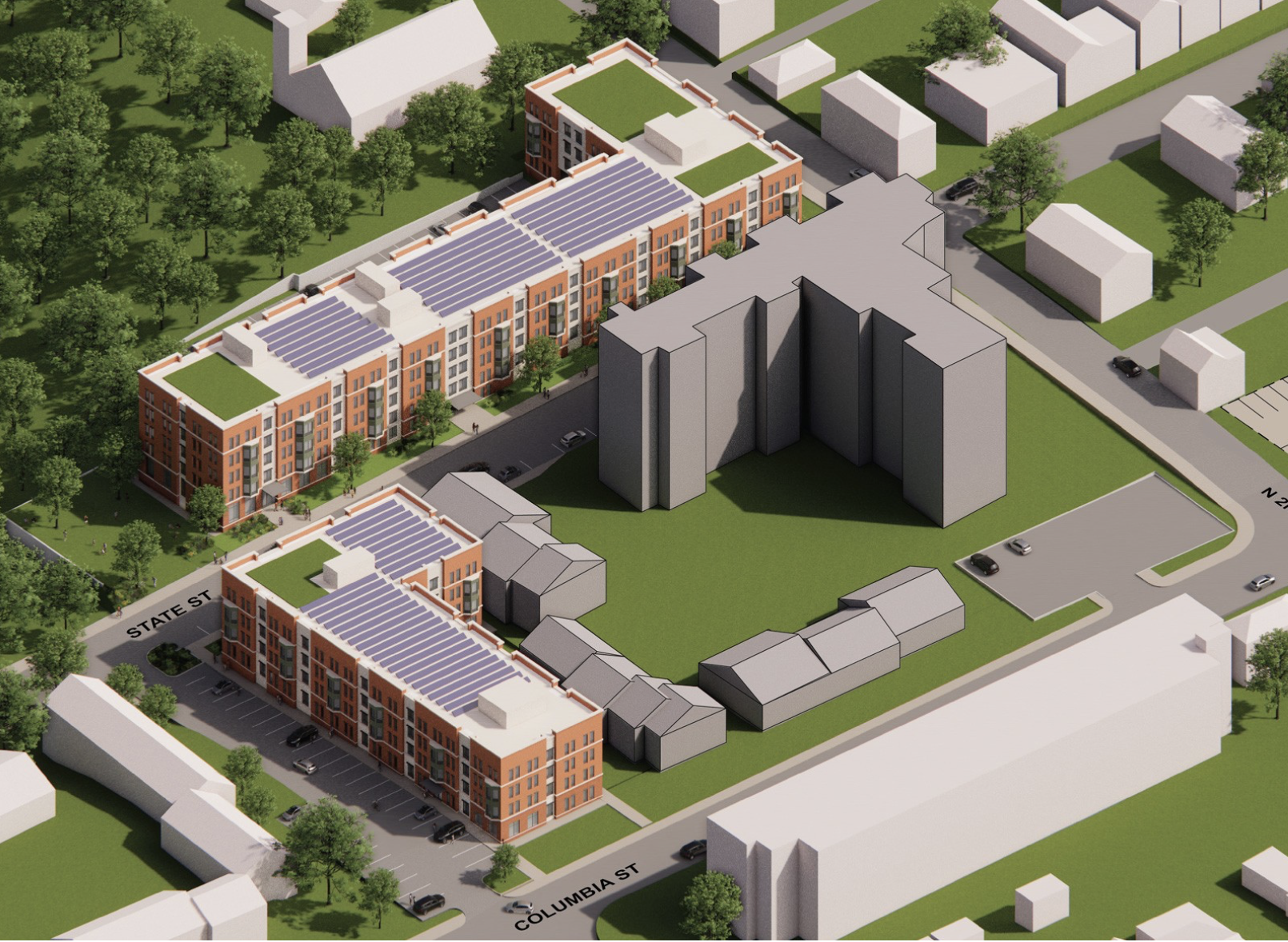
Applicant rendering —
What happens if Phase 2 does not proceed?
Above: The applicant’s Phase 1 rendering shows the new buildings in color, while Bliss Towers and Columbia Apartments remain in gray. Current residents would move into the new homes when they are ready. At the September 30 Planning Board meeting, a Mountco representative acknowledged that there is “no guarantee phase two will happen.” If demolition funding is not secured separately, could the old buildings remain standing—and vacant—beside the new homes?
Applicant renderings are illustrative and subject to change.